About
At the beginning of 2024, the 5-year COMLAWEU (Communicating the Law in Europe, 1500-1750) project was launched at the School of History of the University of St Andrews. Its core aim is to investigate how the communication of law took place in 16th, 17th and 18th-century Europe, and what impact this had on the development of European political society.
In early modern Europe, laws were issued and promulgated by a great variety of political authorities. Most of these authorities relied on an inherited system of communication that required laws to be read out (proclaimed) and distributed in handwritten or printed forms. The extent of these efforts naturally depended on the breadth of the jurisdiction of the issuing authority: proclamations made by the King of France would have to be made across a country of almost twenty million people, while laws issued by the Parlement of Bordeaux would be restricted to a much smaller region. Municipal laws often extended only to a single urban community and any rural territory owned by the city beyond their walls. Many people would have been subject to overlapping jurisdictions, each with a need to communicate their laws: for instance, a citizen of seventeenth-century Rotterdam would be faced with ordinances by their town council, but also the local Admiralty, the States of Holland, the States General, and several other administrative and financial bodies.
Why did this process matter? The paradox of early modern politics was that authorities claimed great authority, but were able to exercise only very limited political power. Monarchs and other rulers possessed, in principle, unchallengeable sovereignty over the lives of their subjects, yet without the active support of those subjects, as well as many smaller and overlapping jurisdictions, the authorities were helpless.

Image: Edict of Louis XIV on the punishment of ‘Diviners, Magicians, Sorcerers, Poisoners’ and the regulation of ‘Dangerous Drugs’, 31 August 1682 (Source: Wikimedia Commons).
If most ordinary people were excluded from the chambers of the state where policy was formulated, they were fully involved in the enactment of the law, which demanded public communication, and placed the rulers and ruled in a shared communal space, such as the market square. The communication of law was steeped in ritual ceremonies, but these were by no means ceremonies in which only the rulers played an active role. The announcement of a new edict provided subjects with the occasion to voice their concerns or disapproval. Citizens also petitioned for changes in legislation, or the announcement of new laws. When the authorities announced a new ordinance, or repeated an older proclamation, they went to great pains to justify their decision to do so, in lengthy preliminary remarks which often divulged that the legislation was actively demanded by a group of their inhabitants.
Image: Louis XIII’s heralds proclaiming the declaration of war with Spain in 1635, attributed to Jan Luyken, 1701 (Source: Rijksmuseum)
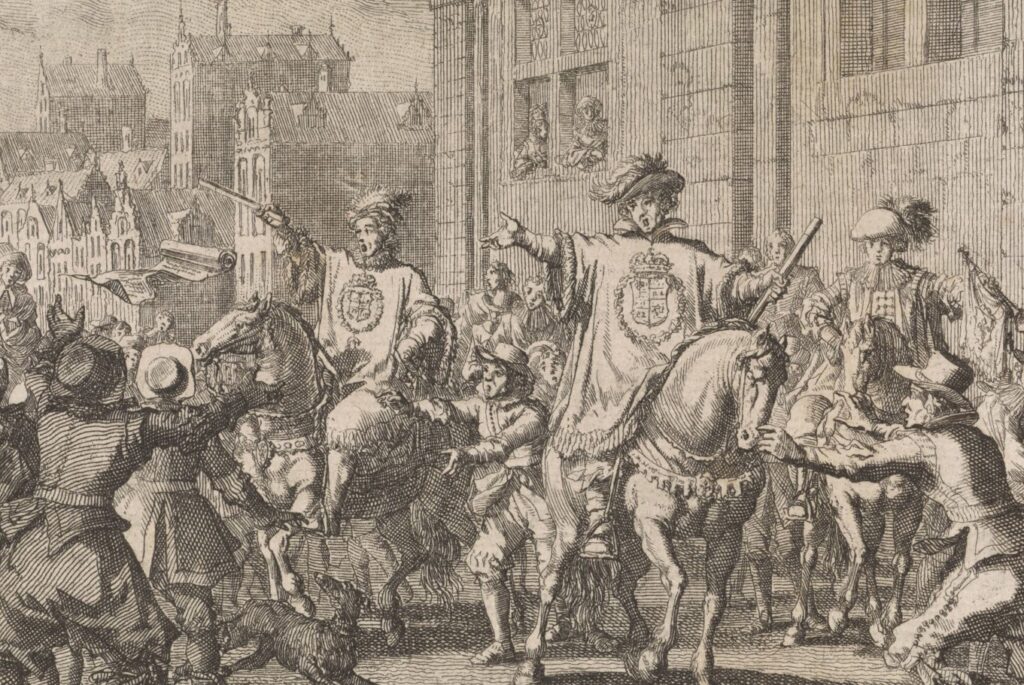
The practice of verbal proclamation was rarely sufficient to reach all of those to whom the law applied. In many towns, use was made of town criers, who would often also be charged with the affixing of copies of new laws at all locations where they made their announcements. These locations were both practical and symbolic, places where many people would congregate: they generally included the town hall and market squares, in front of churches, gates, other notable buildings, and on busy commercial streets. After the town crier had moved on, affixed copies of the law could be consulted by literate inhabitants, scrutinised, or read out to the illiterate. Many were also reprinted for commercial distribution.
The COMLAWEU team, made up of seven scholars, seeks to offer multiple comparative frameworks through which the communication of law can be studied, including Protestant and Catholic states, urban and rural areas, and empires, national kingdoms and city-states. With the aid of such a comparative lens, it will be the overarching aim of the project to analyse how the public dissemination of law shaped early modern civic society and influenced political participation and accountability before the onset of the democratic age.